
The rock identifier that shows its work.
Photograph the stone in your hand for a shortlist, then narrow it down with tests you can run at home. When two minerals can't be told apart without a lab, Stoneye tells you so.
Download on the App Store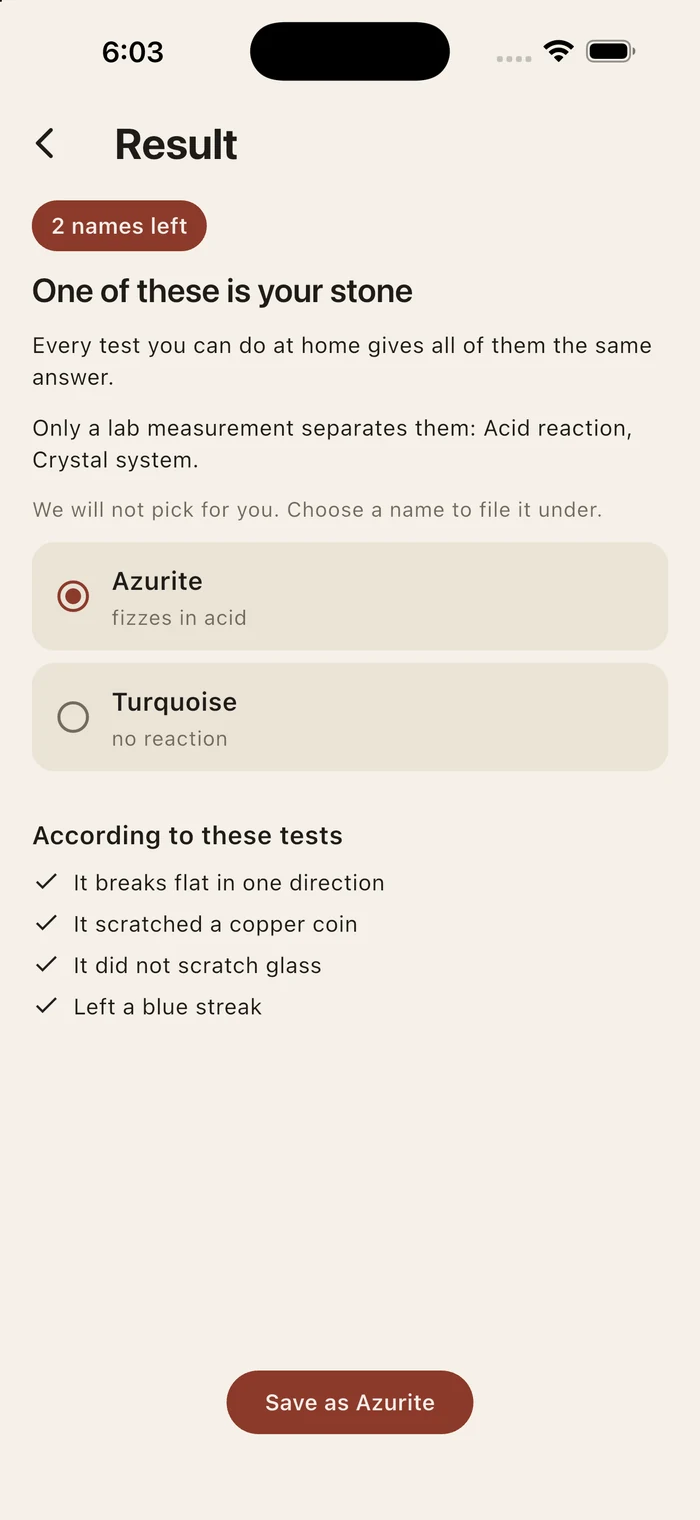
The model only makes the shortlist
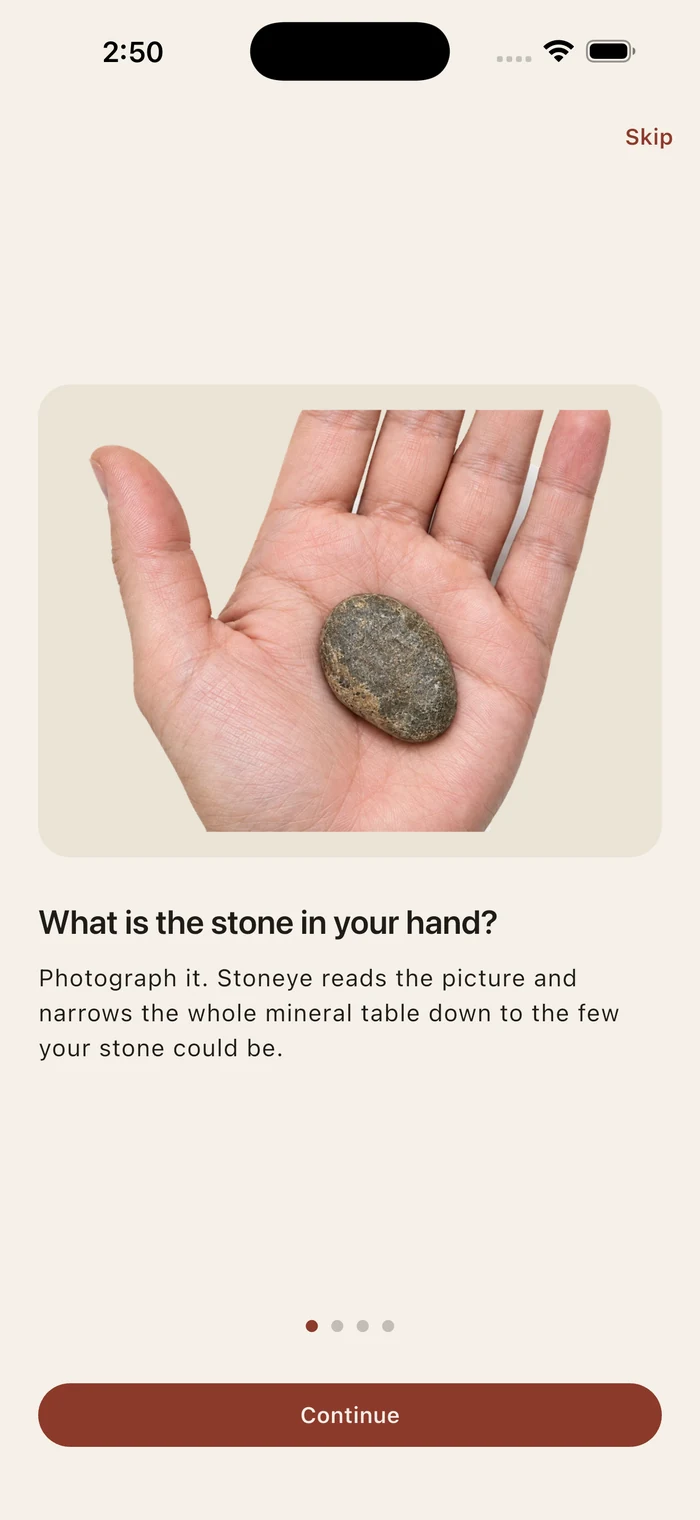
Photograph the stone and a vision model reads the picture. Its one job is to propose the few minerals your stone could be. It doesn't pick the answer.
Most identifier apps print whatever the model says, which is why three photos of the same rock can get three answers. Here every decision after the shortlist comes from a table of 201 minerals, each value checked against a cited source. The same answers always give the same result.
Then you test it at the kitchen table
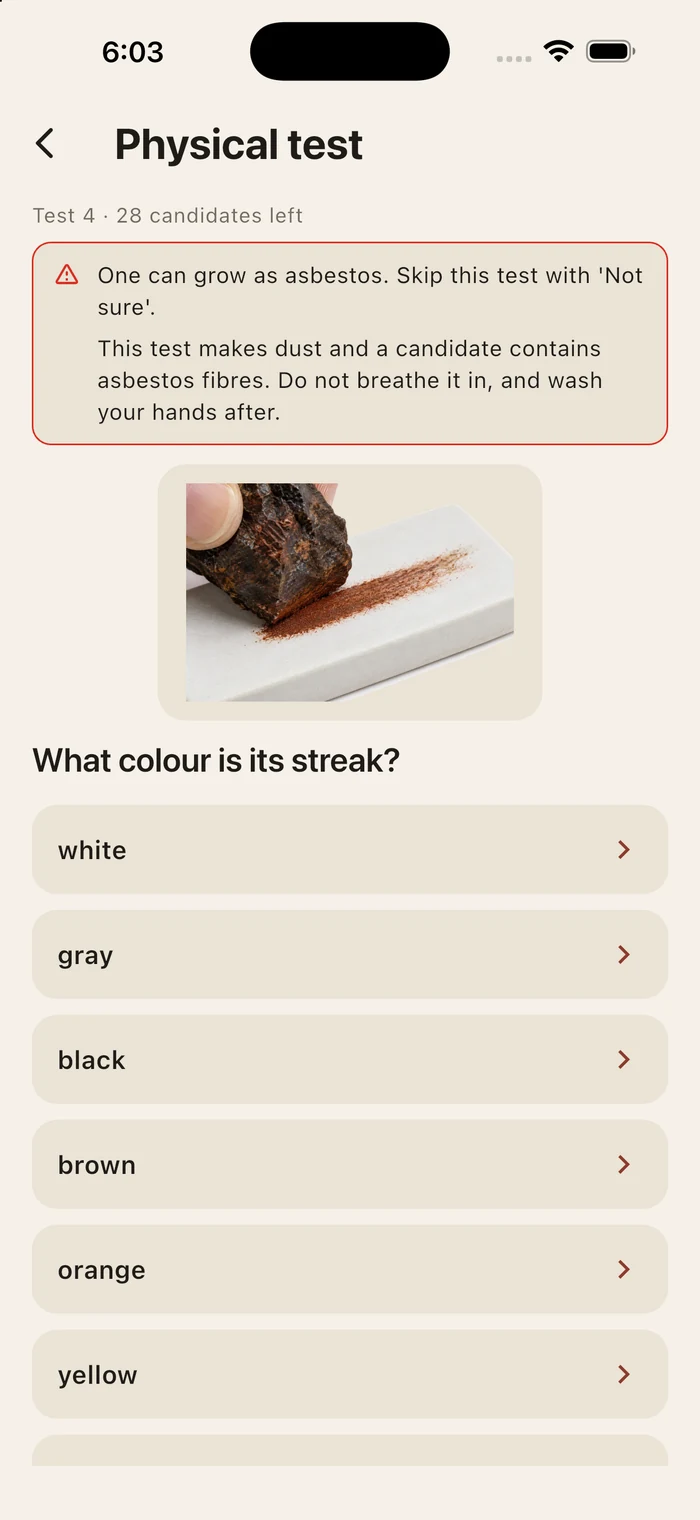
Does it scratch glass? What colour streak does it leave on unglazed porcelain? Does it break along flat faces? Each answer removes minerals from the list. From a photo it's typically 1 question, never more than 2.
Some of these tests make dust, and 25 minerals in the table are harmful as dust: the asbestos group, and minerals carrying arsenic, lead, mercury, antimony or radioactivity. The warning appears before you make the dust, only on the test that makes it, and only while a flagged mineral is still on the list. For asbestos the advice is not to run the test at all, and skipping it costs you nothing.
When it can't tell, it says so
Many minerals give identical answers to every test you can do at home. When that's where you end up, Stoneye shows the names that are left, says which lab measurement would separate them, and lets you choose the one to file it under.
It answers “I don't know” rather than guessing. A mineral name that isn't in the table never reaches your screen: the server filters it out, and the app filters it again without trusting the server.
The whole table works offline
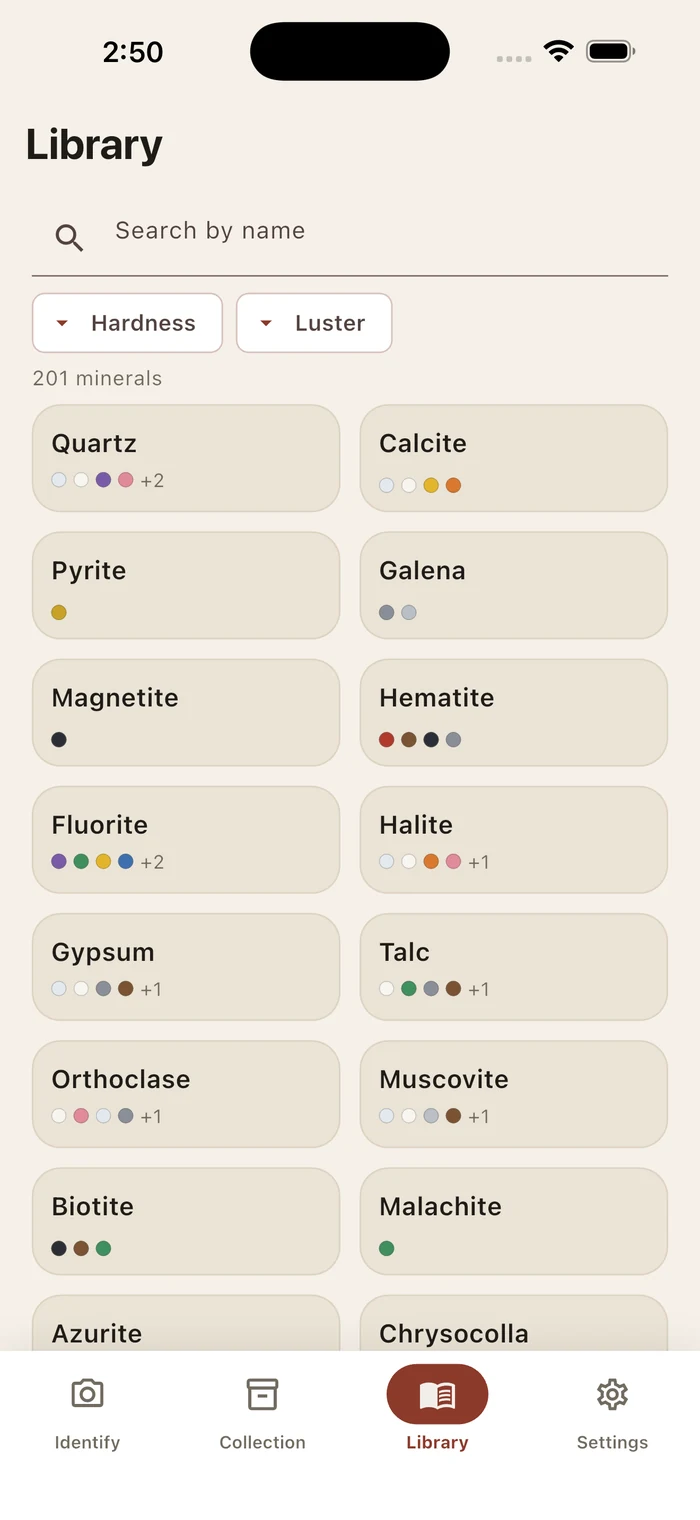
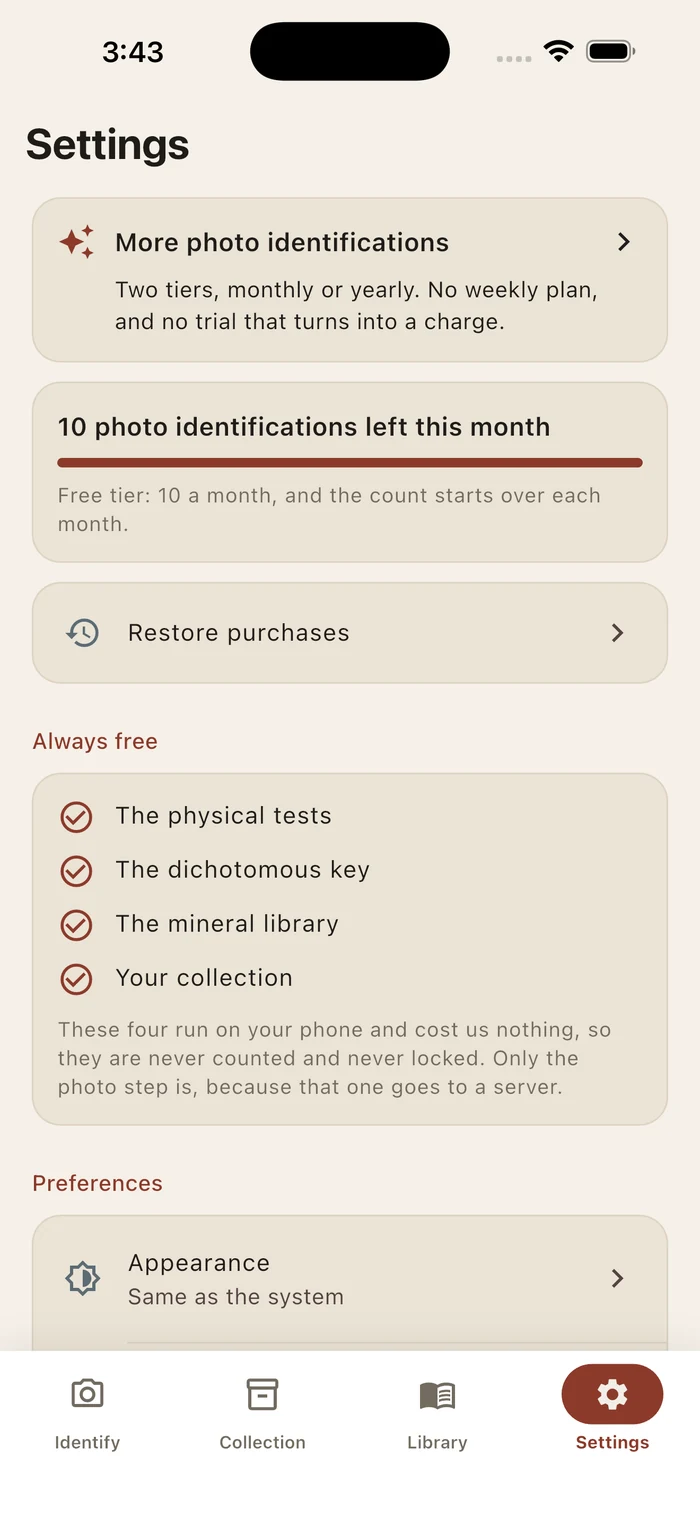
The physical tests, the full key across all 201 minerals, the reference library and your collection all run on your phone. Only the photo step needs a connection, and when there isn't one the app takes you through the key instead of failing.
With no photo at all, the key typically needs 5 questions, never more than 7.
Free, except the part that costs money
Every test, the full key, the library and your collection are free and unlimited. They cost nothing to run, so nothing sits behind a wall.
Photo identification is counted because it's the one step that goes to a server: 10 a month free, 100 with Stoneye Pro, 300 with Stoneye Studio, monthly or yearly. We don't say “unlimited” because it wouldn't be true. No weekly plan, no trial that turns into a charge, and no lifetime plan.
What we measured
We ran the engine against every mineral in the table, both from a photo's shortlist and through the whole table with no photo.
- Question from a photo, typically
- 1
- Never more than 2
- Questions with no photo
- 5
- Never more than 7
- Minerals in the table
- 201
- Every value cites its source
- Wrong answers
- 0
- Across every run, both ways
We measured the limits too. Only 30 of the 201 minerals come down to a single name with tests you can do at home, and about 4% of all mineral pairs can't be separated that way at all. Two names is the usual ending, not a failure, and the app is built around it.
Privacy
No account, no sign-up, no database. Your photo is sent for identification and isn't stored; there's nowhere for it to be stored. Location data is removed on your phone before the photo leaves it.
With your permission, this website uses Google Analytics to count visits. Nothing loads until you choose, and the app itself has no analytics at all.